


In the English language, using two or more words with similar meaning is called redundancy. This means that you can safely keep only one word, and omit others in the phrase. Today we will understand how to spot redundancies and get rid of them.
Here is how redundancy looks like:
The former alumnus of Harvard was elected as a mayor of his hometown.
He head money sufficient enough to buy a new car.
I was going to send an email to you.
Expressions highlighted by bold are redundant. You in the first sentence you can keep only “alumnus” as it denotes former student of a school, “sufficient” in the second one is the same as “enough” , and writing “email you” instead of “send an email” will let anyone understand what you were going to say here.
To keep your writing clean you’d better avoid such repetitions, as they make your text look crowded and hard to read. Moreover, sometimes redundancies give the impression that you do not fully understand what you are writing about.
Types of redundant expressions
There are three main types of redundant expressions.
Type #1. Adjectives with the same meaning as the word they describe
I was invited to their annual anniversary party.
If you put the word “anniversary” to the dictionary, you’ll see that it means ‘the date on which an event took place in a previous year’ which clearly denotes its annual nature. So you can keep only a noun in this phrase with no harm to its meaning.
Type #2. Adverbs repeating the meaning of a verb
This often happens when you use verbs with prefixes like re- denoting repetition. For example:
After figuring out that the new ad campaign does not work out, it was reverted back to the previous one.
Here it would be much better to say that the ad campaign was reverted to the previous one.
Type #3. A group of words with identical meaning
Sometimes people put in the sentence a group of words each of which has identical meaning. The result is always confusing:
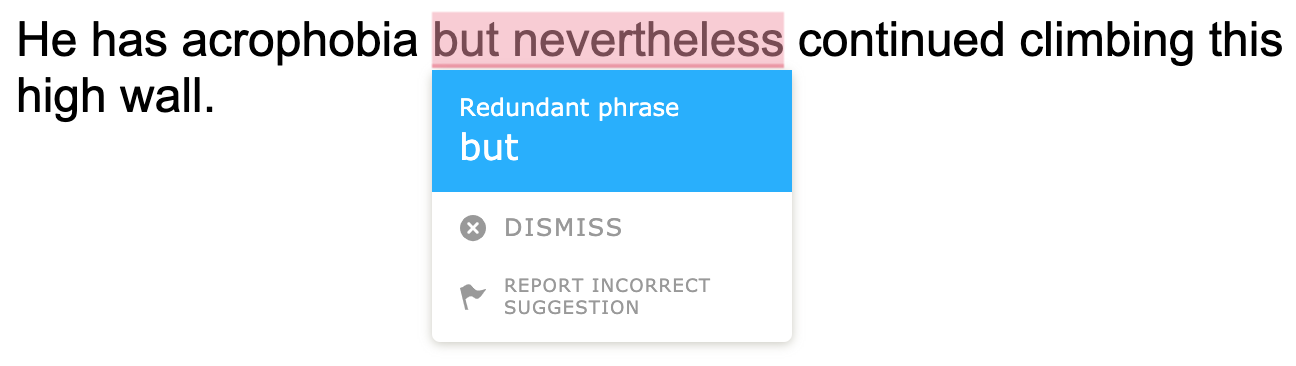
He has acrophobia but nevertheless continued climbing this high wall.
“But” is the same as “nevertheless,” so using both of them is excessive here.
How to spot and get rid of redundancies in your writing
It is a tricky question. The only solution for fighting redundancies by your own is to develop your knowledge of English words meanings. Train yourself with a dictionary; a lot of practice is critical here. However, it will take you a long time until you will be able to spot most of the redundancies in your sentences.
Other way is to use software tools that will be able to do the job for you. For example, to cover your back and be sure your writing is always clean and effective, use Linguix Premium. Our algorithm perfectly spots redundancies and generates suggestions for fixing issues in your writing.
In a matter of seconds, you will be able to fight redundancies, fix your grammar, and get other recommendations crucial for a good writing style. All with our Chrome or Firefox extension.
Good luck with your writing!
Quick redundancy checklist
Use this short checklist each time you edit a sentence to remove unnecessary repetition and tighten your writing.
- Check adjective-noun pairs: does the adjective repeat something the noun already implies (e.g., “past history”)?
- Look for verb + adverb combos that repeat the verb’s meaning (e.g., “assemble together”, “reverted back”).
- Spot paired conjunctions or linking words doing the same job (e.g., “but nevertheless”).
- Test removals quickly: mentally delete one word – if the meaning stays intact, drop it.
- Read the sentence aloud; extra words often sound awkward or slow the rhythm.
When in doubt, consult a dictionary for precise meanings and prefer the clearer, shorter option.
FAQ
Is a small redundancy ever acceptable?
Yes – occasional redundancy can add emphasis or a conversational tone. Use it intentionally, not by habit.
How do I catch redundancies during proofreading?
Do a dedicated pass focused only on word economy: shorten phrases, remove duplicate modifiers, and apply the “delete test” to suspect words.
Are there common red-flag phrases to watch for?
Yes – watch for pairs like “ATM machine,” “PIN number,” “free gift,” “past history,” and verb-adverb doubles; they’re frequent sources of unnecessary repetition.


