

Do you ever have problems spelling English words? Join the club. Nearly every single native English speaker, even academics, would say the same thing: English spelling is tough! That’s because it makes no sense, particularly in relation to the pronunciation.
There are spelling rules in English, but they are frequently broken. And irregular versions can be more common than their regular alternatives. It’s a bit of a nightmare for everybody. But that’s just the way it is, unfortunately.
The difficulty of English spelling is one of the main reasons why so much time is spent on spelling when kids are at school. Usually every week there is a spelling test to be had. And of course there are spelling bees – popular contests where kids compete to become spelling champions – all over the place, particularly in the United States.
So, what are the ten hardest words to spell in English? Well, no list can be definitive, but those included here are certainly among the most frustrating. And you’ll notice that some of these words are not even that complicated, but it doesn’t change the fact that people still regularly misspell them!
Their
It’s ‘e’ and then ‘I’ – so many people have problems remembering that combination. Fortunately, spellcheck services, such as the one offered by Linguix, can fix that mistake automatically for you. And it’s definitely not ‘there’, or ‘they’re’ – they are a totally different word.
Think of all the other words that have this combination of letters.
‘weird’
‘foreign’ (with the added pain of a silent ‘g’)
‘leisure’ (which is also pronounced completely differently in Britain, compared to the United States)
Believe it or not, there is an even a rhyme that is taught at school to help with spelling this combination. It goes like this:
”i’ before ‘e’ except after ‘c’.’
Except in ‘their’, ‘weird’, ‘foreign’, and ‘leisure’, of course!
At least the rhyme works in the word ‘receipt’! But then it’s got that ‘p’!
English, huh?!
Embarrassment
So how many ‘r’s and how many ‘s’s? It’s actually two of both, but you will see so many other combinations it would make you laugh, or cry!
Double letters always cause a problem when spelling in English. Speaking of which…
Misspell
How ironic that the word ‘misspell’ is so easy to misspell. Once again, it’s the double letters that cause the problem.
A little trick that helps here is remembering that the prefix is ‘mis’, and the word is spell. Add them together and of course you will have two ‘s’s. Hope that helps!
Calendar
Along with the ‘I + e’ combination, and double letters, knowing if a word should be spelled with an ‘a’ or an ‘e’ is a nightmare in English. Don’t think about the pronunciation, because that won’t help either.
Calendar is a typically example, because most people think that final ‘a’ should be an ‘e’. Because it sounds like one when you say the word. But it isn’t!
English, huh?!
Affect / effect
So many people get these words confused, mostly because we pronounce them the same way. However, ‘affect’ is the verb, and ‘effect’ is the noun. So…
“The budget of a movie seriously affects the quality of the special effects.”
That little sentence should help you remember the difference.
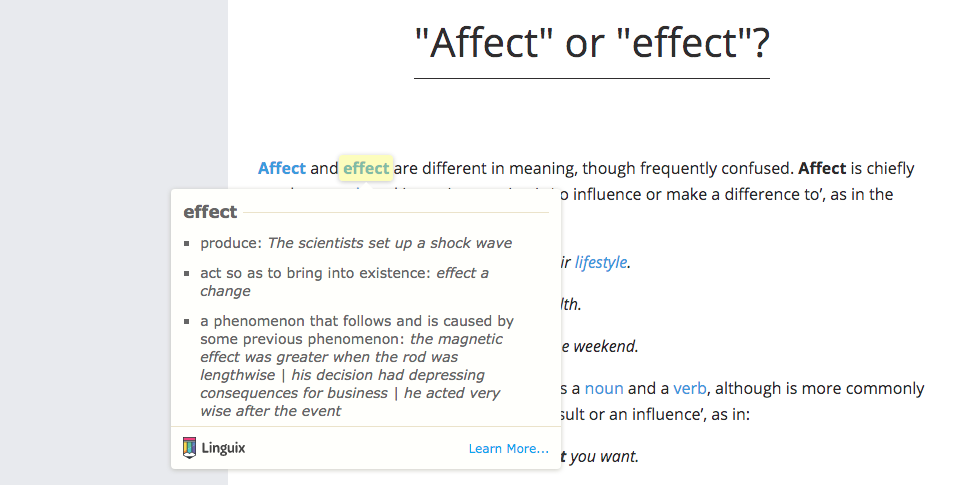
And why not use an online tool such as Linguix, which can give you the definition of the word with a simple click of the mouse. In that way, you’ll be sure to use the correct word in context.

Playwright
Shakespeare was a playwright, because he was a man who wrote plays. But shouldn’t that then mean that he was a play + write? Nope, because in old English, a ‘wright’ was a word which meant worker, so a cartwright was someone who built or fixed carts, for example.
Hence, playwright!
English, huh?!
Pronunciation
Another ironic word, because you may be able to pronounce it (notice the added ‘o’), but you won’t be able to spell the word pronunciation (wait, what happened to that ‘o’?)
Rhythm
When you get a word that doesn’t have any vowels, you have a real recipe for disaster. But where most people are okay with ‘gypsy’, the word ‘rhythm’ causes many more problems. There is no ‘e’!
Separate
We are back to our old friends ‘a’ and ‘e’ again. Remember ‘calendar’, well now meet ‘separate’! That middle vowel is an ‘a’, not an ‘e’. Don’t try saying the word again, it’s not going to help you!
Until / till
The formal word ‘until’ has only one ‘l’, but the shortened form ’till’, which is also acceptable to use, has two ‘l’s.
‘Why?’
That is a question you never, ever ask about English spelling!
Quick tips to remember tricky spellings
When a word keeps tripping you up, break it into parts: prefixes, roots and suffixes are often regular even when the whole word looks odd. Writing a word slowly by syllable or saying the letters aloud can help lock the correct sequence into memory.
Use simple mnemonics and tiny rules you can check quickly – for example, turn difficult pairs into short reminders (“Affect = Action” versus “Effect = End result”) and keep a small list of common exceptions to the “i before e” rhyme.
Practice words in context rather than isolation. Making a short sentence that uses the target word, or typing it several times while thinking of its origin (Latin, French, Old English) will help the correct form stick.
- Their / they’re / there: replace with “they are” to test for “they’re”; use possession imagery for “their” (something belonging to them).
- Double letters: split the word into prefix + base (mis + spell → misspell) or visualize the doubled letter as a bridge or mirror.
- Rhythm and other vowel-sparse words: learn them as whole chunks rather than trying to infer vowels from sound.
- Pronunciation vs. spelling oddities: check if a part is an archaic root (wright in playwright) to explain odd letter choices.
FAQ
Is the “i before e” rule worth memorizing?
It can be useful as a quick check, but treat it as a guideline rather than a law. Learn the most common exceptions and focus on remembering those individually-it’s quicker than trying to apply the rule to every new word.
How do I stop confusing affect and effect?
Use a one-line test: if you can replace the word with “influence” or perform an action, it’s likely “affect” (verb). If the word means a result or outcome, choose “effect” (noun).
Any fast way to master double-letter traps?
Look for familiar chunks (prefix+root) and practice typing the word correctly a few times in a sentence. Creating a tiny visual cue-like imagining two identical objects for the doubled letter-also helps recall.